
Chemp: A Dream Carried by the Wind
Published on: January 15, 2026
Reading time: 7 minutes

Welcome — and welcome back, my brave readers.
At the end of October, I took a short trip to the Aosta Valley and, beyond the always breathtaking landscapes, this time I chose to explore a lesser-known side valley and discovered within it an incredible treasure. Months have passed and I still find myself thinking about it, so today I’d like to tell you about Chemp: a dream carried by the wind.
This rather poetic definition is the one preferred by its creator, sculptor Angelo Giuseppe Bettoni, known as Pino. It was he who envisioned saving Chemp from abandonment — a tiny, isolated mountain village at around 800 metres above sea level, in the Lys Valley, within the municipality of Perloz, not far from Gressoney.
The encounter between him and Chemp, much like my own, was the result of chance. Around the age of fifty, he visited the village in a state of complete abandonment: ruined houses, brambles, tall grass, and nothing but the sound of leaves and wind. As he himself recalls, not even birds could be heard — they return to sing only where there is human presence.
From that moment on, he committed himself to purchasing one of the buildings, restoring it, and moving there to live. And there he still lives today, more than thirty years later. Pino is now 84 years old and continues to reside in Chemp. The number of inhabitants has grown to three: people who devote themselves entirely to carrying forward his dream — to bring this extraordinary alpine village back to life, a place whose origins date between the 17th and 18th centuries.
Chemp was originally created as a base for alpine pastures, yet it was a carefully maintained and well-structured village, something that can still be clearly seen today. It had a school, the inevitable church, and even the notary’s house. The alpine architecture here is striking: a perfect balance between practicality, resistance to harsh weather, and attention to detail.

The Lys Valley, just a little further north, is historically marked by the presence of the Walser people. Chemp is not a Walser village in the strict historical sense, but it clearly engages in dialogue with that alpine culture. One can find here a beautifully restored granary inspired by Walser architectural techniques: suspended and supported by large stone mushroom pillars (cap-stone columns), an ingenious solution designed to keep rodents and moisture at bay.
Between the second half of the 19th century and the early 20th century, the metallurgical industry — already an important source of employment in the area — experienced a major expansion. Some plants came to employ over a thousand workers, marking the beginning of the gradual and inevitable abandonment of small mountain villages such as Chemp.
The village thus remained uninhabited for many decades. A symbolic moment marking Chemp’s return to life can be identified in 1997, the year when the village’s first “inhabitant” was flown in by helicopter: a magnificent bronze sculpture created by Bettoni, depicting a woman merging with the wind, placed on a plateau overlooking the village and the valley below.
From that moment on, the project never stopped. Chemp gradually became populated with figures carved in wood (and some in metal) — living memories of those who had once truly inhabited the village.
These figures portray simple, everyday gestures: Mirella feeding the chickens or carrying hay; children playing and suddenly appearing around a corner; people chopping wood, washing, dancing. Animals emerge quietly and watchfully — and hidden among them, one may even encounter small folkloric creatures.
Today, Chemp is home to over 80 works of art: many created by Pino himself, others donated by around thirty artists who, over time, became deeply involved in his vision, contributing to the village’s repopulation through their works. Various initiatives have been launched over the years to support this dream, including the association “Friends of Chemp”, which helps care for and maintain the village.
In 2018, a crowdfunding campaign was also launched to support the publication of a photographic book that included, among other contributions, poems by Umberto Druschovic, a contemporary poet from the Aosta Valley. Fragments of his verses can still be read today while walking through the village.

OF EARTH AND STONE
There is an ancient pain
always unspoken,
a fate already written
in those born among stones,
among wood and straw
of a humble stable.
A lost love,
a misplaced dream,
a denied smile
that carries regret,
a crust of bread
to be torn apart with teeth,
a life of little worth
made of toil and hardship.
There is a marked path
in those who have roots
of earth and stone.
Not all people
are granted the same fortune.
Those born in the mountains
carry something inside
they keep to themselves
with quiet humility.
Those born in the mountains
are like seeds fallen among stones.
It is the ancient destiny
assigned to leaves
to remain faithful
to their own path
to accept their fate
and let themselves be carried by the wind
to return to the earth,
like river water
flowing back to the sea.
Umberto Druschovic
This English translation was made by me. Those who wish to read the original Italian version of the poem can do so here.
The book is currently difficult to find and is often listed as out of print. If you are interested in looking for it, the link provided here points to Libreria Universitaria, one of the few sites I found that still indicates the possibility of placing a reservation.
I had the privilege of discovering Chemp on a beautiful sunny day, without the presence of other visitors. I felt all the emotions that Pino intended to convey: discovery, wonder, and a silence broken only by the sound of leaves and the wind that dominates the valley.
Every corner offers something to observe. The level of detail is so carefully considered that it leaves a strong impression. I don’t think I have ever encountered a work as colossal as Chemp, because it is not a village — it is a complete work. It is art, history, architecture, poetry, care, and love. It is wood, metal, stone… It is emotion.
As you know, I have explored many trails and places over time, and I have shared the most beautiful ones here with you. Each of them is engaging, well cared for, and meaningful. Yet none of them has managed to grasp so deeply the intention of bringing a place back to life, which is very different from simply bringing people to it. And please don’t misunderstand me — I value both.
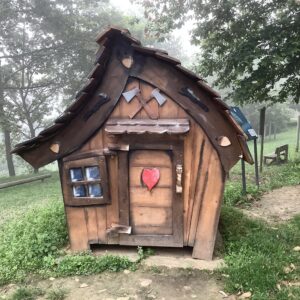
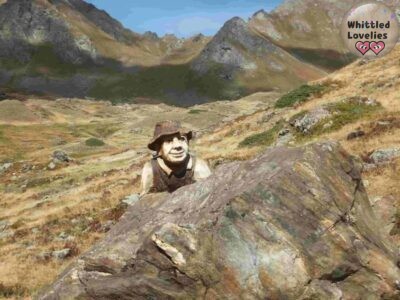
Here, I imagine Pino in the morning, greeting Mirella as she stands on the steps with her bundle of hay, while he sets off to run his errands. Because they are statues, yes — but they are also people. Ancient and real, like those we see in photographs from ethnographic museums. Their presence is so vivid that you almost find yourself expecting to meet them in person.

There are also sculptures that combine an extreme attention to detail with a poetic image that is never trivial, always in harmony with the surrounding environment. Like the woman with the child in front of the church, whose garments seem to dissolve into the wind.
I haven’t included many photos, because this is a place that needs to be seen with your own eyes. It isn’t something I can show you — it’s something you have to experience. I made a short video simply to whet your appetite, but it was while filming it that I truly understood how different this place is. What I can show you is beautiful, but it is only a small part of what Chemp is able to communicate.
Everything in Chemp is sensory — profoundly so. There is not a single installation that does not engage in dialogue with the place it inhabits. Even the works by other artists are perfectly integrated: nothing feels out of tune, everything is fused into a single breath, and this alone is enough to inspire wonder.

It is a village made of very few houses, almost clinging to the mountain ridge. You can spend hours there and still never be certain you have seen everything. Even retracing your steps and walking the same path in the opposite direction, the same work may reveal a detail you missed before or take on a different meaning. It is remarkable.
Chemp is another example of how delicate the balance is between bringing people to a place so it can live, and bringing too many so it does not die. Pino has done all this with a clear vision: to share his love for Chemp, so that such beauty would not remain private, but accessible to all.
Still, it must always be remembered that this is a gift.
A gift to be held with hands trembling from emotion. It should not be consumed, damaged, or left depleted. It should be visited with care, attention, and deep respect. Reaching it is not easy: the roads are very narrow, parking is almost nonexistent. This is not a place for the masses. But it is a place worth every bit of effort it takes to get there.
Go there — because it will fill your eyes and your heart, and you will return changed. But go consciously. Step into this dream gently, on tiptoe.
This is Chemp.
This is an article written by a human for humans!
All articles in the blog are written by me. No contributors, no people paid to write content for me.
Posts written by guests or friends of the blog are marked under the title with the words “guest post.” These are friendly collaborations, contributions to the carving community.
No AI (artificial intelligence) support is employed in the writing of blog articles, and all content is made with the intent to please humans, not search engines.
Do you like my content?
Maybe you can consider a donation in support of the blog!

Click on the button or on the link Ko-fi to access a secure payment method and confidently offer me coffee or whatever you want!
From time to time, in my articles, you’ll find underlined words or buttons with the 🛒 symbol. These are links that lead to further insights, or affiliate links to selected products that I use or would personally choose for the same kind of project I’m talking about.
The price for you stays the same, but by purchasing through these links you help me grow the blog and keep sharing the world of wood in a free and independent way. 💛