
Wood Tourism in the Cuneo Valleys: Wood, Villages and Trails
Published on: October 15, 2026
Reading time: 11 minutes
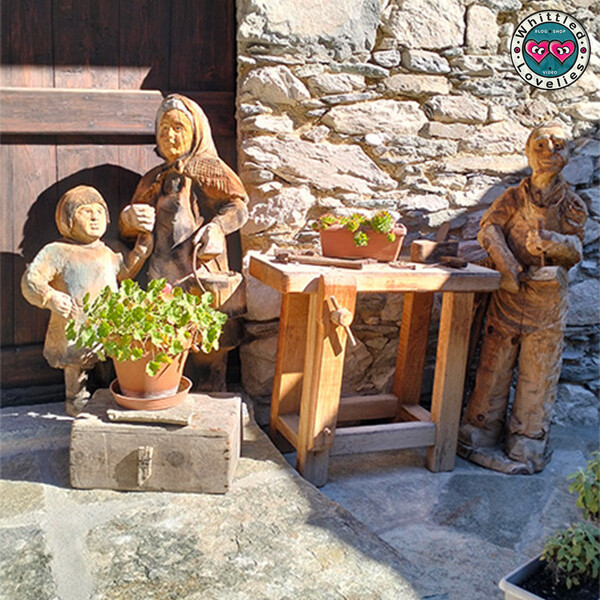
An itinerary through the Maira and Varaita Valleys, from the Gnomes Trail and Rio Bello Canyon to Chianale, Torrette and the Sarvanot Trail: wood carvings, Occitan villages, nature, legends and traditions.
Hello everyone! Last weekend I set off to admire the autumn colors in the valleys of the Province of Cuneo (Italy). At least, that was the official plan…
The real plan, of course, involved stopping in front of every sculpture, door, balcony, old tool, neatly stacked woodpile and sufficiently interesting piece of timber I encountered, until I completely forgot that I was theoretically there to admire the foliage. I know myself by now: I may choose the most innocent, generic destination imaginable, but the moment something carved appears, my attention immediately changes hands. 🤦🏻♀️
Over two days, I traveled through the Maira and Varaita Valleys in Piedmont, Italy. I returned to the wooden Gnomes Trail in Prazzo almost five years after my first visit, finally kept an old promise at Rio Bello Canyon in Villar San Costanzo, wandered among the stone-and-wood houses of Chianale and Torrette, and ended the trip in the forest of the Sarvanot in Rore.
As I moved from one stop to the next, I realized that this was not simply a weekend devoted to autumn and wooden sculptures. It also contained nature, Alpine architecture, craftsmanship, restored villages, vanished trades, Occitan legends and communities trying to keep their home places alive.
In other words, it was exactly what I have recently begun calling Wood Tourism. I have been using this expression on the blog and in my videos for a while, but I have never properly stopped to explain what I mean by it. It is time to put that right.
What Does Wood Tourism Mean to Me?
Wood tourism, as I now call it quite naturally, does not simply mean going for a walk in a forest. Otherwise, every stroll among trees would automatically belong in this category, and I could declare this article finished after three lines—to the great delight of my chronic editorial delays. 😇🤣
Nor does it simply mean looking for places filled with wooden sculptures. To me, wood tourism is a genuine way of traveling centered on destinations where wood itself has something to show: carved, sculpted, crafted, used in construction, reclaimed, or transformed into art, architecture and a testament to the past.
It may lead us along a trail populated by sculptures, into an artisan’s workshop, to a fair devoted to woodworking, through a museum, around a village distinguished by its timber architecture or to an ancient mill. Wood does not necessarily have to be the only protagonist, but it should play a significant enough role to make the place worth visiting rather than being there merely by chance.
To me, this is the fundamental difference: my idea of wood tourism is not about counting how many sculptures we encounter, but about understanding what wood can tell us about people, landscapes and the passage of time, and, of course, about the skill, ingenuity and sensitivity of those who worked it in the past and continue to work it today.
I had already touched on this while discussing my now well-established wood obsession. If you truly love this material, sooner or later it changes the way you travel too. You no longer look only for a beautiful view: you begin choosing destinations partly for what you will be able to see there in wood and for the many ways in which it has been crafted, preserved or reimagined. This weekend in the Cuneo valleys was a perfect example.
First Stop:
The Gnomes Trail, Almost Five Years Later
The journey began in the Maira Valley, with a return to San Michele di Prazzo and the Remo Einaudi Trail, known to almost everyone as the wooden Gnomes Trail.
This was not a new discovery. I had already written about it in The Gnomes Path: Discovering the Maira Valley. At the time, I photographed the trail and told you about its small Alpine hamlets, old mills and the works of Barba Brisiu, but I never made a proper video.
That omission had stayed with me: small, but irritating. A kind of editorial gnome that occasionally emerged from behind a tree to remind me: “Lovely article, but where is the video?” 🤣 So I went back. Revisiting a place after almost five years is a curious experience. The first time, you try to see everything; the second time, you begin to notice what has changed.
The sculptures themselves, exposed to the seasons, have become part of the natural cycle. Their colors have altered, the wood carries the marks of time and some figures seem even more integrated into the forest. They no longer give the impression of having simply been placed beside the trail. They look as though they have claimed their own corner among the roots, leaves and stones.
The route begins near Borgata Chiesa and crosses several other small settlements, including Castiglione, Chiotto and Rabiera. Here, woodcarving does more than decorate the walk: it invites us to look more carefully. We search for gnomes, animals and woodland spirits, but meanwhile we begin noticing the mills, the traditional buildings and the way these tiny hamlets fit into the mountain landscape.
This time I finally made the video. As always, it does not replace the old article but completes it. The article preserves the story of my first visit; the video shows the trail as it is today and makes it possible to compare the two experiences several years apart.
This is another aspect of wood tourism that matters to me: not collecting destinations simply to cross them off a list, but occasionally returning. Returning means seeing how the artworks change, whether the trail and its installations are cared for over time, and whether a restored village continues to be genuinely lived in.
Sometimes a new trail is inaugurated, photographs are taken, people talk about it for a few months and visitors arrive. Then the spotlight moves elsewhere, and suddenly nobody seems interested anymore. The problem is that a sculpture placed in a forest does not preserve itself. The day it is unveiled, another story begins, one made of rain, sunlight, frost, maintenance and people willing to take responsibility for it.
Returning does not necessarily mean bringing more visitors. It means following a place over time and continuing to talk about it after it has stopped being the novelty of the moment, without concentrating sudden crowds in areas that are often small and environmentally delicate.
I had already considered this risk in my article about Belvedere Garden: promoting beauty is important, but we should try to be a blessing to these places, not the cause of their decline.
Through my idea of wood tourism, I would also like to encourage a more conscious and environmentally responsible way of traveling: walking, observing, respecting what we encounter and understanding how much work is required to preserve it. Forests, villages and works of art should not be treated as scenery to consume as quickly as possible. They are living places, worthy of our attention even after the first visit.
Rio Bello: A Promise Finally Kept…
A Few Years Late 🤦🏻♀️
In my old article about the Gnomes Trail, I wrote that a new route featuring around twenty carved wooden animals was being created inside the “Ciciu del Villar” Nature Reserve. I also added:
“I can’t wait to try it, and as soon as I manage to visit, I’ll tell you all about it in another article!”
“As soon as I manage,” according to the Whittled Lovelies calendar, can apparently mean four years later. The important thing is not to specify that in the terms and conditions. 😂
At last, I reached Rio Bello Canyon – the Fairy-Tale Trail, inside the Ciciu del Villar Nature Reserve in Villar San Costanzo.
The place is worth visiting even without the wooden sculptures. The Ciciu are unusual erosion columns consisting of compact reddish earth topped by large blocks of gneiss. The columns did not “lift” the stones. Instead, water and atmospheric erosion gradually removed the surrounding soil, while the earth protected by the boulders remained standing.
The result is a forest populated by enormous mushrooms, halfway between geology and a fairy tale. Evidently, someone decided that all this already fascinating landscape needed was a community of wooden animals!
The Fairy-Tale Trail opened in May 2022. It is a simple educational loop of approximately 800 meters, designed especially for families and schools.
Hidden along the canyon, in rocky recesses, among the trees and beside the stones, are 21 sculptures by the ever-present Barba Brisiu, an artist as talented as he is prolific: wherever I go, one of his works seems to have arrived before me. 🤣
The animals represent species found inside the reserve, but they have been humanized and are busy performing traditional trades. Every character combines nature, humor and the memory of work. The forest becomes a miniature community, while its animals act as guardians of activities that modern life risks making less and less visible.

Part of the fun lies in finding them. Some figures reveal themselves immediately, while others require a little more attention. The trail works precisely because it does not display everything as though it were sitting on a shop shelf. You have to look among the rocks, follow the stream, which was unfortunately dry during my visit, and give yourself enough time to discover who might be working around the next corner.
It is a short walk, but not an empty one. It proves that the quality of an experience does not necessarily depend on the number of kilometers covered or on an enormous quantity of artworks. What matters is the relationship created between the sculptures, their environment and the story being told.
Rio Bello also fulfills the promise I sensed several years ago: using woodcarving to introduce children to wildlife, traditional trades and nature without turning everything into a stern-looking lesson. You learn almost without realizing it, which is often the best way to learn.
The official description and current visitor information can be found on the pages dedicated to Rio Bello Canyon and the Ciciu del Villar Nature Reserve.
From the Maira Valley to the Varaita Valley
On the second day, I changed valleys.
There is actually a spectacular Alpine route connecting the two. When the road is open and accessible, you can leave the Maira Valley through the hamlets of Stroppo, pass beautiful Morinesio, reach Elva and then cross the Colle di Sampeyre, at an elevation of 2,284 meters, before descending directly into the Varaita Valley. For anyone staying in the middle or upper Maira Valley, this is an exceptionally scenic alternative that avoids returning all the way to the plains.
Be careful, though: the Colle di Sampeyre is a high-altitude mountain pass with seasonal access. Before choosing this route, always check current road conditions and the official regulations issued by the municipalities of Elva and Sampeyre.
I wanted to travel through the Varaita Valley from bottom to top and watch it change as I gained elevation. So I chose the less cinematic solution: I drove back down toward the plains, crossed from one valley to the other and started climbing again.
Chianale:
Wood Within Alpine Architecture
The highest destination of the day was Chianale, in the Varaita Valley. Located at an elevation of 1,802 meters, it is the highest settlement of the historic Castellata area and the last village before the Colle dell’Agnello mountain pass, which leads into France. The Varaita stream divides the village into two sections, joined by its characteristic stone bridge. Here, wood does not need a themed trail to attract attention. It is inside the village itself.
The houses combine stone, slate and timber, with roofs covered in traditional stone slabs known as “lose“. Many buildings have been restored while preserving the appearance and character of Alpine architecture. Walking through the narrow streets means continually encountering beams, balconies, doors, old tools and everyday objects that tell stories about work and mountain life.
This is precisely the kind of place where my walking speed becomes worryingly slow. 🤣 A normal person sees a beautiful house and carries on. I have to inspect the door, decide whether a beam is genuinely old—and here I noticed some even dating back to the 1600s!—study the way a balcony has been repaired and determine whether the tool hanging on the wall is a decoration, a family memory or both.

Near a venue that also preserves a collection of old objects, I found several beautiful wooden sculptures. There are not enough to turn Chianale into a village of statues, and, ultimately, there is no need.
Its value lies in the whole: in the artworks, the structural timber, the preserved objects and an architecture that has been restored without completely erasing its identity. The past has not been embalmed. It has been made liveable again.
Torrette:
When a Village Becomes a Story
On the way back down through the Varaita Valley, I also stopped in the hamlet of Torrette, known as “La Toureto” in Occitan, within the municipality of Casteldelfino.
Torrette stands on a rocky spur and once occupied an important strategic position as an outpost of the historic Dauphiné territory. Here too, the restoration of the buildings has revealed the beauty and structure of Alpine architecture: stone, wood, narrow passageways, courtyards and small details that encourage visitors to walk slowly.
Old objects, tools, decorations and works by different hands appear on the houses. Wooden sculptures are far more numerous here than in Chianale, and some recall the traveling trades once practiced by local people and the history of emigration from these valleys.

Torrette has become a kind of story spread throughout the village, built from objects, sculptures and memory. Perhaps that is its most interesting quality.
A village cannot be saved simply by restoring its physical structure. Walls are essential, of course, especially if we would prefer the roof to remain above our heads. But keeping a place alive also means giving it back a shared story and a reason to be visited, understood and remembered once again.
In villages that have experienced depopulation and emigration, this matters. Tourism does not automatically solve the problems faced by mountain communities. But curious, thoughtful tourism that takes a genuine interest in local culture can help keep attention alive.
Wooden statues cannot perform miracles on their own, but they can attract someone’s gaze, spark curiosity and persuade a traveler to stop, a traveler who might otherwise have continued along the main road without ever knowing that a beautiful little village existed just a short distance away.
“The Sarvanot” Trail and
“Tumpi la Pisso” Waterfall
The final stop was Rore, a hamlet of Sampeyre, where I followed the Sarvanot Trail toward the Tumpi la Pisso waterfall.
The Sarvanot belong to the legendary heritage of the Alpine valleys. They are described as small, human-looking creatures: hairy, shy, intelligent and extremely touchy. They live in forests, among roots and inside rocky crevices. They often emerge at night and enjoy playing tricks on human beings.
The installations frequently portray them in imaginative and even amusing ways, but I still find them rather unsettling. Gnomes can at least look friendly. The Sarvanot give me the distinct impression that turning my back on them for too long would be unwise. Rather than spoiling the walk, however, this adds exactly the right amount of suspense. 😎🕵️
The trail begins in Rore, at an elevation of approximately 890 meters, and follows the Rio Cantarana through the forest. It takes roughly half an hour to reach the waterfall. The complete loop described by Alpi Cuneesi covers approximately 2.6 kilometers and normally takes just over an hour—not including the time required to find all the creatures and wonder whether one of them has just moved. 😳🤔

Along the route, you encounter bridges, information panels and installations. Some are simple, while others are genuinely imaginative. Certain pieces make intelligent use of shapes, hollows and materials that were already present in the forest. Not everything has to be technically perfect or carved on a monumental scale to work. Sometimes the right idea, placed in the right spot, can create a much stronger interaction than an isolated work of art.
Nature is not merely a backdrop here: it is part of the scenery. The sound of water grows louder as you approach the Tumpi la Pisso waterfall. The route crosses the stream several times on spectacular suspended bridges, while figures seem to watch us from places we might never have noticed without them. Even if we forget the Sarvanot for a moment, the landscape alone makes the walk worthwhile.
The installations, however, add the dimension of legend. Thanks to the work of the Lu Rure cultural association, which maintains the trail and has collected local stories, a creature from oral tradition does not remain trapped inside a book. It symbolically returns to its own environment, allowing walkers to encounter part of the Occitan imagination. In this way, the forest, the artworks and the stories all support one another.
Another Sarvanot Trail
If the world of the Sarvanot has made you curious, there is another similar route in the Grana Valley, also in the Province of Cuneo: the Sarvanot Trail of Monterosso Grana.

Here too, you will encounter Sarvanot, carved wooden figures, land-art installations, such as a beautiful passage made from intertwined vines, and other entertaining surprises hidden in the forest. If, after visiting Rore, you have not yet had enough of being watched by strange creatures among the trees, it could be an excellent idea for another day out.
A complete route is available on Wikiloc. The suggested itinerary also includes two detours toward San Pietro and the Chapel of Our Lady of the Snow, so it is longer than the Sarvanot Trail alone.
Wood as a Thread Running Through a Place
By the end of the weekend, I had seen many very different things: chainsaw sculptures, small creative installations, animals transformed into workers, legendary creatures, restored houses, tools, mills, bridges, beams and doors. What connected them was not simply the physical presence of wood, but this material’s ability to make places speak.
This is the kind of wood tourism that interests me: not a hunt for the biggest or most spectacular attractions, but a way of connecting nature, creativity, craftsmanship and cultural heritage. It is an invitation to step outside the workshop and observe what other hands, other communities and other centuries have made from wood.
Visiting a small village, stopping to look, reading an information panel, entering a museum, buying something from a local artisan or telling the story of a trail cannot solve the problem of abandonment on its own. It can, however, help us recognize that a place has value. And before value can be protected, it must first be seen.
Wood is particularly well suited to this task because it carries time on its surface. It ages, changes color and preserves the marks left by tools and seasons. It does not pretend to be eternal, but it can last long enough to connect people who lived far apart in time.
Perhaps this is what I am really looking for whenever I set off on a wood tourism journey: not simply new works to admire, but traces of the relationship between people and the material I love. Of course, if I also happen to find a gnome, a carved animal or a Sarvanot that looks sufficiently non-threatening along the way, I certainly will not complain.
See you next time! 🤗😘
This is an article written by a human for humans!
All articles in the blog are written by me. No contributors, no people paid to write content for me.
Posts written by guests or friends of the blog are marked under the title with the words “guest post.” These are friendly collaborations, contributions to the carving community.
No AI (artificial intelligence) support is employed in the writing of blog articles, and all content is made with the intent to please humans, not search engines.
Do you like my content?
Maybe you can consider a donation in support of the blog!

Click on the button or on the link Ko-fi to access a secure payment method and confidently offer me coffee or whatever you want!
From time to time, in my articles, you’ll find underlined words or buttons with the 🛒 symbol. These are links that lead to further insights, or affiliate links to selected products that I use or would personally choose for the same kind of project I’m talking about.
The price for you stays the same, but by purchasing through these links you help me grow the blog and keep sharing the world of wood in a free and independent way. 💛